We use cookies - Our website uses cookies to provide you with a better experience as well as for analytical purposes. For more information on our privacy practices and cookie policy please read our Privacy Policy.
|

DLP vs LCD Projectors

One of the most common questions we are asked is whether DLP or LCD is best for projectors.
While they are both suitable for most common applications such as teaching, training or business presentations, there are some differences which may be important when choosing the right projector for your specific needs.
In this guide, we will explain how DLP projectors and LCD projectors work as well as their advantages and downsides.
If you need further help, do not hesitate to contact us for advice.
DLP PROJECTORS
What is DLP technology?
The DLP® chip was invented by Dr. Larry Hornbeck of Texas Instruments in 1987.
It is probably the world's most sophisticated light switch. It contains a rectangular array of up to 2 million hinge-mounted microscopic mirrors; each of these micromirrors measures less than one-fifth the width of a human hair.


When a DLP® chip is coordinated with a digital video or graphic signal, a light source, and a projection lens, its mirrors can reflect a digital image onto a screen or other surface. The DLP® chip and the sophisticated electronics that surround it are what we call DLP® technology.
How does DLP work?
1-chip DLP® projector system
Televisions, home theater systems and business projectors using DLP® technology usually rely on a single chip configuration like the one below.
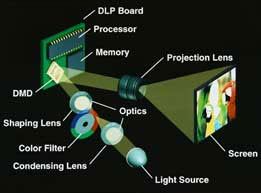
White light passes through a colour filter, causing red, green, blue and even additional primary colours such as yellow, cyan, magenta and more to be shone in sequence on the surface of the DLP® chip. The switching of the mirrors, and the proportion of time they are 'on' or 'off' is coordinated according to the colour shining on them. Then the sequential colours blend to create a full-colour image you see on the screen.
3-chip DLP® projector system
DLP® technology-enabled projectors for very high image quality or very high brightness applications such as cinema and large venue displays rely on a 3-chip configuration to produce stunning images, whether moving or still.

In a 3-chip system, the white light generated by the lamp passes through a prism that divides it into red, green and blue. Each DLP® chip is dedicated to one of these three colours; the coloured light that the micromirrors reflect is then combined and passed through the projection lens to form an image.
Click to see a video about how DLP works
Advantages and Disadvantages of DLP
Advantages
- Because the "pixels" (mirrors) are so close together, there is less of a "chicken wire" effect.
The "chicken wire" is a phenomenon by which the grid-like structure of the panel on LCD projectors is visible on the projected image. On DLP projector this effect is greatly reduced making the image appear softer and smoother. This is more noticeable in video applications and at lower resolutions. - DLP projectors achieve higher contrast ratios.
- DLP projectors tend to be quieter.
- DLP projectors tend to be smaller and lighter than their LCD counterparts because the system only requires one panel instead of three.
- Because they have sealed optics, DLP projectors are ideal for dusty or smoky environments such as clubs.
Disadvantages
- A few DLP projectors users can suffer from the "rainbow effect" described as brief flashes of rainbow like "shadows" most often seen on high contrast areas of moving bright/white objects on a mostly dark/black background such as the credits at the end of a movie.
The technology has improved greatly over the years reducing the amount of people who notice this effect. - Although this is barely noticeable on the latest models, DLP projectors aren't as good as LCD models at rendering colours. This can be important for photography clubs or where the corporate colours need to be spot on.
Click to browse DLP projectors currently available.
LCD PROJECTORS
What is LCD technology?
Liquid Crystal Display (LCD) projectors pass light through LCD panels about the size of a postage stamp; the LCD panel is made up of miniscule panels ('pixels') that can be clear, opaque or some semi-clear point in between. These pixels take the form of the image to be created, and the light passes through the clear or partly-clear areas in the same way that light passes through the clear or gray parts of a negative.

The projector's lens, in turn, expands the image and directs the light onto the screen or viewing surface. This enlarges all the tiny details and creates clear, detailed and beautiful images with ultra-smooth movement.
How does LCD work?
A light source (lamp or laser) projects white light onto a combination of dichroic mirrors that split the light into its three basic video colours: red, blue and green.
Each of the three colours of light is then passed through its own LCD panel. Each LCD chip takes the electrical signal it receives and creates an image.
The three colour images are then combined using a prism to form a full-colour image consisting of millions of colours which passes through a lens and is projected onto a screen.

Click to see a video about how LCD projection works
Advantages and Disadvantages of LCD
Advantages
- LCD gives a sharp image which is preferable in high detail data applications.
- LCD generally produces colours with a higher accuracy than DLP which is important in applications such as photography or where corporate colours in a presentation need to be precise.
- LCD has more colour saturation which increases the perceived overall brightness.
- LCD projectors are more "light efficient" than DLP projectors meaning given the same wattage lamp, the LCD projector will produce a brighter image.
Disadvantages
- Older models suffer from the "chicken wire" effect, although newer model have improved and it is less visible on resolutions such as XGA and virtually invisible at higher resolutions from normal viewing distance.
- LCD projectors don't achieve as high a contrast ratio as DLP projectors.
- LCD panels being organic, they degrade over time. The less the machine is used each day, the less of a problem this is. Projectors that are used for over eight hours a day however will have a shorter life span.
Click to browse LCD projectors currently available.
WHICH IS BEST, LCD OR DLP?
As mentioned earlier there is no straight answer to this question. It basically depends on your requirements.
Generally we would advise that if colour reproduction is critical to your application or you need the image to be sharp you should choose an LCD projector.
If you are using the projector mainly for video or require a more portable projector, DLP may be a better choice.
Both technologies are improving all the time and both would be suitable for the majority of applications so when choosing a projector, consider all the other main factors first and only use the technology as a secondary factor in your choice.
If you would like help from one our experienced advisers, please call us on 01924 278464 and we will be happy to recommend suitable models for your application.
Sources: dlp.com, 3lcd.com